by Peter Dreyer
For a full account of Arthur Young’s life and achievements, refer to Nested Time, his “astrological autobiography.”
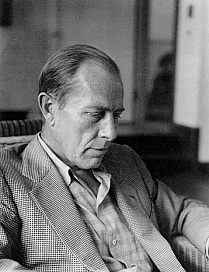
Arthur Young’s life spanned most of the twentieth century (1905 – 1995), and his remarkable accomplishments reflect the challenges and cultural shifts that marked those years. He was a mathematician, an inventor, and a hands-on innovator who was responsible for the development of the Bell helicopter. He was also an astrologer, a delver into myths and dreams, a long-term investigator of psi phenomena, and, most importantly, the elaborator of what may be the first theory that unifies consciousness, physics and the life sciences, the Theory of Process, described in his seminal works, The Reflexive Universe and The Geometry of Meaning.
Upbringing
Arthur’s father, Charles Morris Young, was a landscape painter who had put himself through art school by engraving scenes from the battle of Gettysburg on walking sticks, which were sold to tourists. In 1903 he married Eliza Middleton Coxe, whom he had met at the Academy of Fine Arts in Philadelphia. The couple moved to France, where he had been a student in a Paris atelier, living the frugal life of the artist. It was in Paris that Arthur, the Youngs’ first child, was born on November 3rd, 1905.
When Arthur was one year old the family returned to Jenkintown, Pennsylvania, where he was raised on an old 18th-century farm, Meadow Bank. At the nearby Haverford School, Arthur earned a reputation as an expert gadgeteer. Summers were spent at Mount Desert on the coast of Maine. Here, Arthur started making and sailing model sailboats. His lifelong skill at model making would later prove essential to his work in developing the helicopter.would prove useful in the years to come since it was by way of working with models that he ultimately learned how to make the helicopter fly.
Princeton
After preparatory school, Arthur enrolled at Princeton in 1921. He soon transferred his major from astronomy to mathematics, studying under the prominent mathematician Oswald Veblen. Having exhausted all the available math courses in his junior year, he requested a special course in relativity, which was created and taught by Veblen, with Arthur as the only student. He graduated from Princeton in 1927.
In his final year at Princeton, in response to the tragic death of his younger brother Sandy, Arthur decided to devote himself to philosophy and to develop a comprehensive theory of the universe. Confronting the enigma of time, he changed his developing theory from one of structure to process. Unable to elaborate on what constituted “process” in his theory, he decided to pursue a more tangible goal in which the answers could be tested in the physical realm.
The Helicopter
In 1928 Arthur traveled to Washington to search the files of the Patent Office to see what progress had been made on possible inventions he had in mind. He finally decided to work on the problem of vertical flight, which at that time had a long history of failure. Helped by his boyhood experience of making model sailboats, he began his work by making model helicopters. This self-imposed task would absorb him for almost nineteen years, twelve of them on his own and the last seven with Bell Aircraft Corporation.
In the early 1930s Arthur developed a relationship with Priscilla Page, and they were married in 1933. Following a honeymoon trip to Europe, they rented a house in Paoli, Pennsylvania, and Arthur resumed work on the helicopter. Needing more room, he purchased an old farm in Downingtown, restoring a dilapidated barn that became his workshop.
By 1940, working with models, Arthur had discovered how to provide stability in flight, through the innovation of a stabilizing bar. He then set about showing his machine to potential backers. On November 2, 1941 he assigned his patents to Bell Aircraft, with an agreement to work with the company until the prototype was complete. Five years later, on March 8, 1946, Young’s helicopter, the Bell Model 47, was awarded the world’s first commercial helicopter license.
The Psychopter
By 1947 the helicopter job was essentially done, and Arthur decided to leave Bell and return to philosophy. In 1946 he had happened upon the writings of the Theosophist Helena Blavatsky, and he was also becoming interested in yoga, Zen Buddhism, and Hindu philosophy. Challenged by evidence of the reality of precognitive dreams, Young realized that there was an enormous frontier that had not been covered by science—launching a spiritual quest whose goal he called the “psychopter.”
Even during his time at Bell, Young had continued to speculate about his theory of process. His voluminous diary, part of which was later published as The Bell Notes: A Journey from Physics to Metaphysics, provides considerable insight into the directions in which his mind was moving—away from the difficulties of organization and management on the helicopter project, and toward his own mental and spiritual development.
A key observation in the diary was his understanding of learning. While the scientist and the inventor were both concerned with the laws of nature, the scientist, once having discovered a law, held it sacred. The inventor’s goal, on the other hand, was to apply it–to use a law instead of being confined by it. Young, as an inventor, conceived of law, or determinism, as the agency of free will rather than its antagonist. This was a key insight in his theory of process, since process must create determinism to acquire the means to achieve its goal: “Without purpose, without goal-directed activity, my helicopter could not have evolved. For me this was a lesson in how evolution works. The purpose creates the machine.””
Gee Whiz Period
In 1948, Young was divorced from Priscilla, and that June he married Ruth Forbes, a member of the Boston Forbes family, whom he and Priscilla had met through a mutual friend. In 1949, while living in New York, Arthur and Ruth met MBM (May Benzenberg Mayer) and enrolled in her school, the Source Teaching Society. A student of Freud and Jung, MBM worked with dreams and the study of earlier spiritual traditions. Under her guidance, Young began to record and analyze his dreams, some of which provided clues to his evolving theory of process.
For some five years, during what he later referred to as the “Gee Whiz” period, Arthur and Ruth traveled to investigate phenomena that the scientific establishment simply ignored. On a trip to California in 1951, they met Dr. Oscar Brunler, a practitioner of radionics. Brunler, like MBM, had a profound influence on Arthur’s thinking.
The Study of Consciousness
In 1952, Arthur set up the Foundation for the Study of Consciousness in Philadelphia. In the quest to discover where consciousness fit in the scheme of science, the Foundation funded research by leading figures in the esoteric. Increasingly Arthur began to believe that the key to an understanding of unknown forces might lie in the realm of mathematics. He tried to tell philosophers about the valuable tools from science and from quantum theory in particular, but many felt they could not venture into the complexities of quantum physics, with its formidable mathematics.
The Theory of Process
Exploring the implications of modern quantum physics, Arthur found that the photon, the quantum unit of light, can itself create particles. This provided a starting point for an integration of the findings of science with ancient myths and esoteric teachings that suggested that the evolution of consciousness unfolds in seven stages.
Arthur’s theory of process teaches that the world as we know it can be elaborated into seven stages, which can be depicted as an arc. Process can be seen as a “fall” into the determinate constraint of matter, followed by an ascent in which matter becomes free and indeterminate again: “The primary reality is this activity – which could be light, or it could be seeing, or it could be understanding. …It’s behind all the world of manifestation, and it’s a restoration, in effect, of the spiritual nature of things.”
In 1972, Arthur and Ruth purchased a home in Berkeley, California, with the hope of attracting students to the theory of process through a course at John F. Kennedy University in Orinda, California. In 1973, after many attempts at engaging academics in dialogue, Arthur set up the Institute for the Study of Consciousness in Berkeley, where he attracted a number of students who were eager to learn about his theory, as well as hosting speakers at the leading edge of the emerging “new age” movement. In 1976, having refined the theory through discussion and debate with students and guests, he published The Reflexive Universe and The Geometry of Meaning, which elaborated his ideas.
For the remainder of his long life, Arthur continued to encourage the study and criticism of the theory of process. Its seminal insights, reconciling ancient religious teachings and modern science, inspired other workers to continue to explore this theme. At the time of his death on May 30, 1995, he was still working on applying the language and discipline of the theory of process to unsolved mysteries in science and the exploration of the human spirit.


